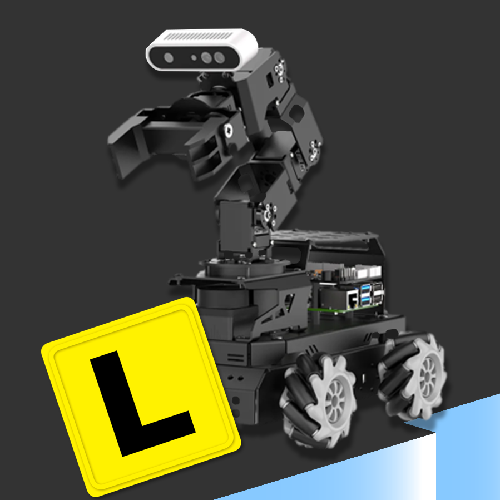
LanderPi: Autonomous Search-and-Rescue
This project was completed as part of a Robotics Control & Automation module during my MSc at Loughborough University.
I designed and implemented a ROS 2 software package for a search-and-rescue scenario using the LanderPi robotics platform.
I integrated perception, navigation, obstacle avoidance, and human–robot interaction into an end-to-end autonomous solution.
System Architecture
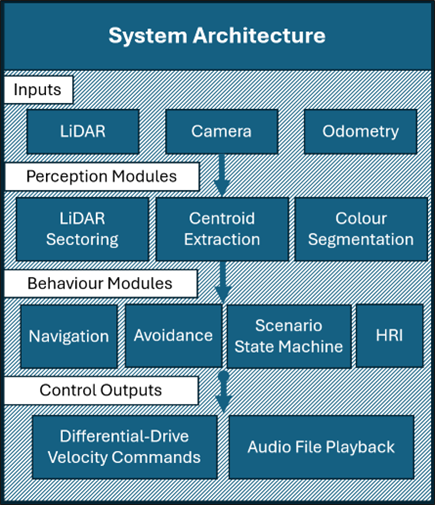
I delivered the project through a modular ROS 2 architecture. Each behaviour module interpreted sensor topics and generated motion commands using differential-drive kinematics.
The modular structure enabled me to make the most of limited on-robot test time; I could quickly replace modules to test specific functionality. I also used ROS 2 parameters to make on-the-fly adjustments.
I designed the software to be hardware-agnostic, requiring only minimal changes to run on an alternative platform.
Vision-Based Navigation
I implemented vision-based navigation throughout the project: a simple line-following program simulated a pre-marked route, and the robot then automatically transitioned to a more advanced beacon-navigation program when it reached the end of the line.
This emulated an IR beacon being dropped in the search area. The software used HSV colour segmentation to detect a green cylinder beacon analogue.
Centroid tracking located the beacon, and I mapped the heading error to angular velocity using PID-based visual servoing.
Reactive Obstacle Avoidance
I integrated reactive obstacle avoidance into the beacon-navigation program using the LanderPi’s LiDAR. When LiDAR range fell below the safety threshold, obstacle avoidance was triggered.
The program then set a flag to gate navigation before yaw-scanning in place, using LiDAR data to select the freer side (left/right sector comparison) and navigate towards it. I used hysteresis to prevent the oscillation observed during testing.
This reactive avoidance strategy with scan-and-select logic enabled fully autonomous navigation through real-time decision making. SLAM was out of scope for the project timeframe.
Human–Robot Interaction
I achieved human–robot interaction through a vision-based gesture recognition interface (core gesture classifier by Fred).
I implemented the following enhancements:
- To prevent false detections, I added a hold-time debounce (~200 ms continuous detection) before confirming a gesture.
- On detection, the robot triggered a response behaviour (wave) and an audio prompt.
- I added a search/reacquisition behaviour: a pan-tilt scan at two elevations, followed by a base yaw-scan to broaden the search area.
Behaviour Control & Autonomy
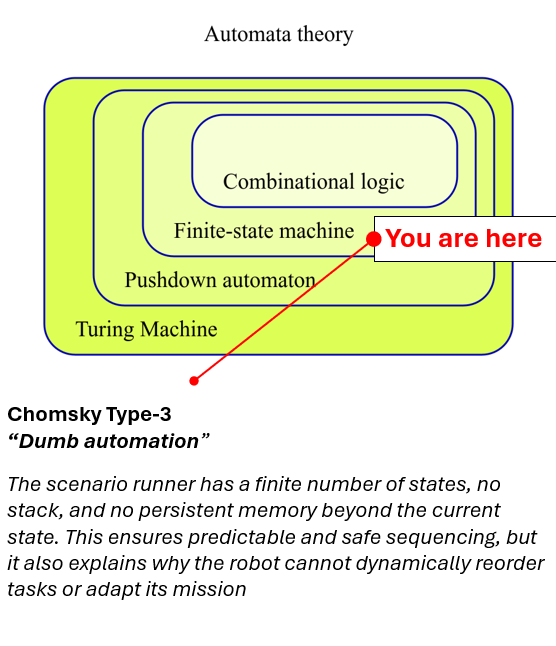
I implemented a finite-state controller to orchestrate the mission and achieve deterministic autonomy.
This module handled behaviour arbitration and conflict prevention and included timeouts and fail-safe handling in the event of a stall condition.
Engineering Constraints & Optimisation
Key constraints included compute budget and limited on-robot testing; I mitigated these by rate-limiting telemetry/logging, keeping perception lightweight, and exposing thresholds and gains as ROS 2 parameters for rapid on-robot tuning.
Outcome
The project delivered reliable autonomous navigation and interaction.
In lab trials, the robot completed the test route, acquired the beacon, negotiated obstacles, and responded to gestures.
I was awarded a first-class grade.
View the source code on GitHub.