
My work formed part of that broader engineering effort and included the development of the software needed to make video-based motion analysis usable in practice. Rather than treating motion magnification as a research demonstration, I developed it as an engineering utility that could support structured investigation and review within the wider NVH workflow. The result was a desktop application designed to process recorded footage, isolate subtle visible vibration, and generate outputs that could be compared against more established NVH measurements.
That comparison was important because no single method gave a complete picture on its own. Microphones were useful for identifying sound pressure levels, tonal content, and blade-passing behaviour. FRF and accelerometer measurements were useful for understanding structural response and transfer behaviour. Phase-based video added something different: a spatial view of where visible motion was occurring on the hardware. Used together, those methods made the analysis more robust by linking what could be heard, what the structure was doing, and where the motion was visible.
The software was therefore designed around traceability and engineering confidence. It captured run settings and metadata, supported quantitative region-of-interest outputs, and added checks that helped distinguish usable motion data from weak or noisy results. That shifted the output away from visually impressive footage and toward evidence that could support technical review and decision-making.
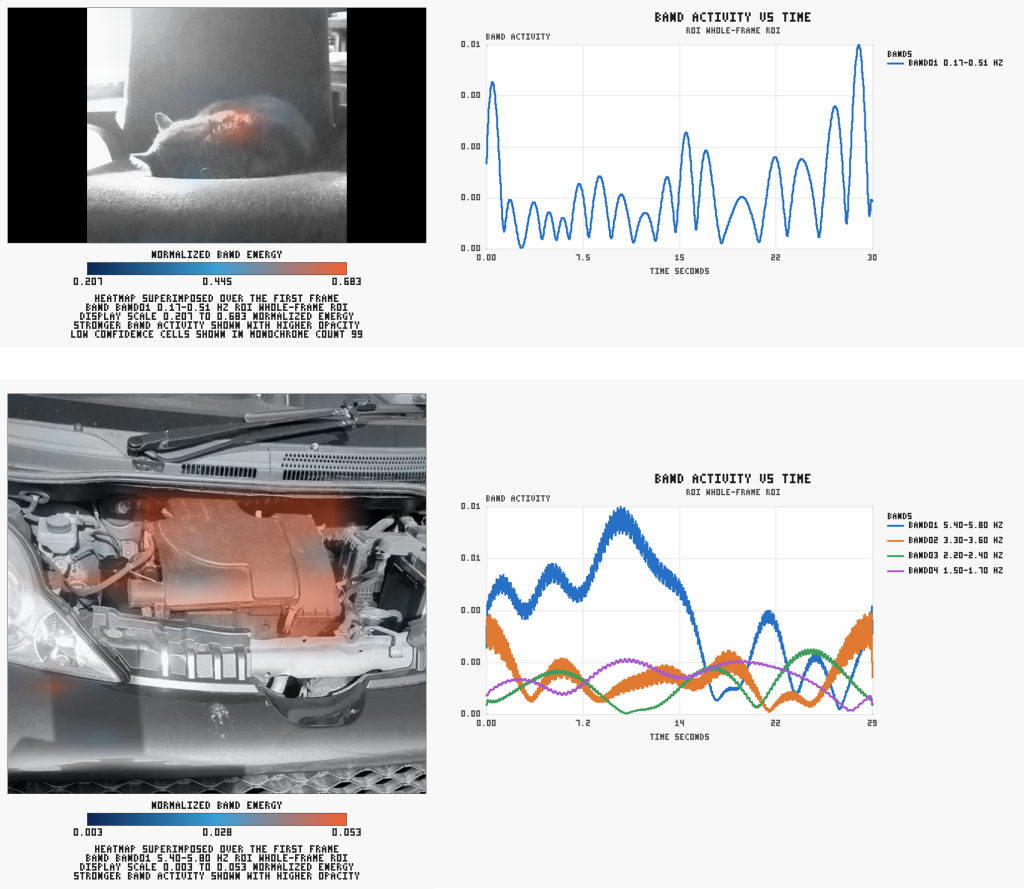
The underlying motion pipeline used the phase-based approach described by Wadhwa et al. (2013), which amplifies motion through local phase variation rather than raw intensity change. For this application, that made it better suited to engineering interpretation than older Eulerian-style approaches, which are more vulnerable to amplifying lighting fluctuation or surface texture as false motion.
View the phasedBasedMotionUtil repository on GitHub for the source code, implementation details, and ongoing development of the tool.