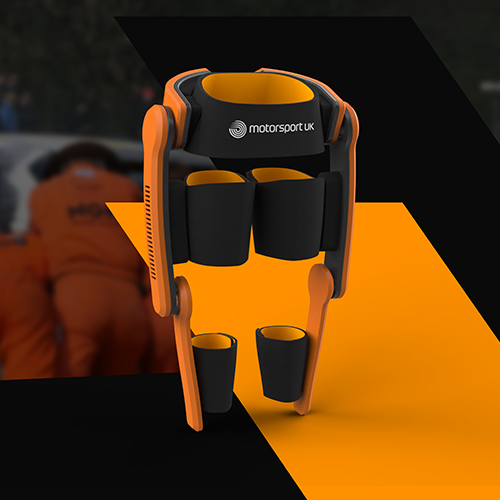
EXO-3 is a lower-body exoskeleton concept developed for Motorsport UK to address an overlooked safety gap in motorsport marshalling. Rather than focusing on the driver, the project explored how wearable support could improve protection, reduce physical strain and preserve mobility for marshals working in demanding trackside recovery situations.
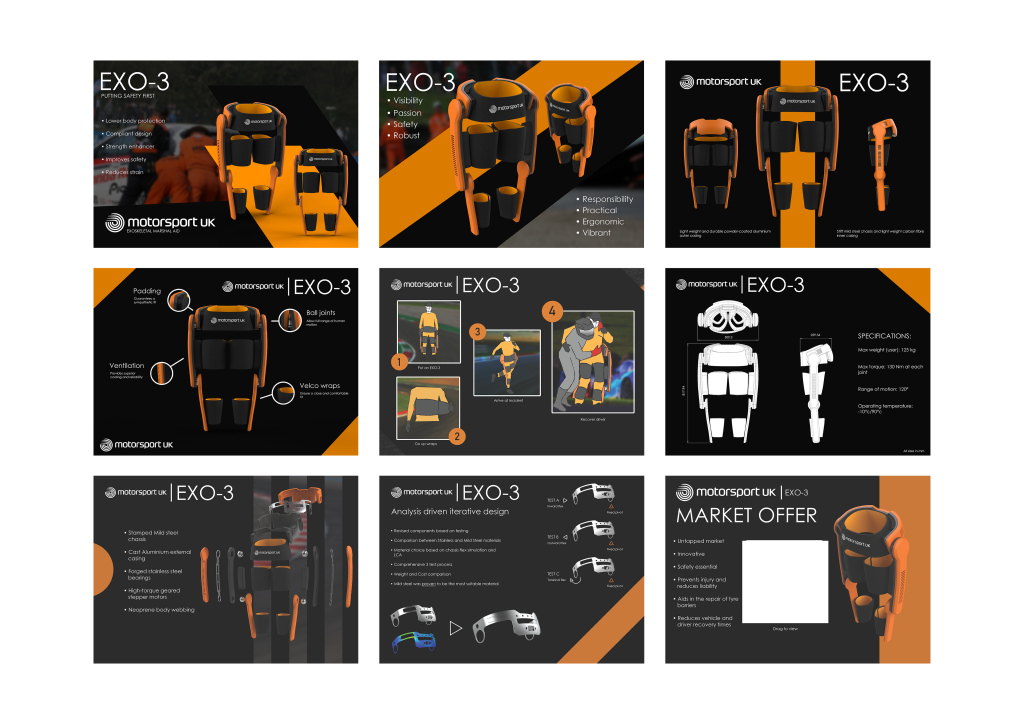
The design was resolved as a full product concept rather than a styling exercise. It combines a pelvic chassis, upper and lower armatures, ball-jointed articulation, cushioning and webbing into a 25-part assembly, supported by GA drawings and a defined CMF specification for finishes, colours and production processes. The result is a concept that balances support, movement and visibility while showing clear consideration for manufacture and product detailing.
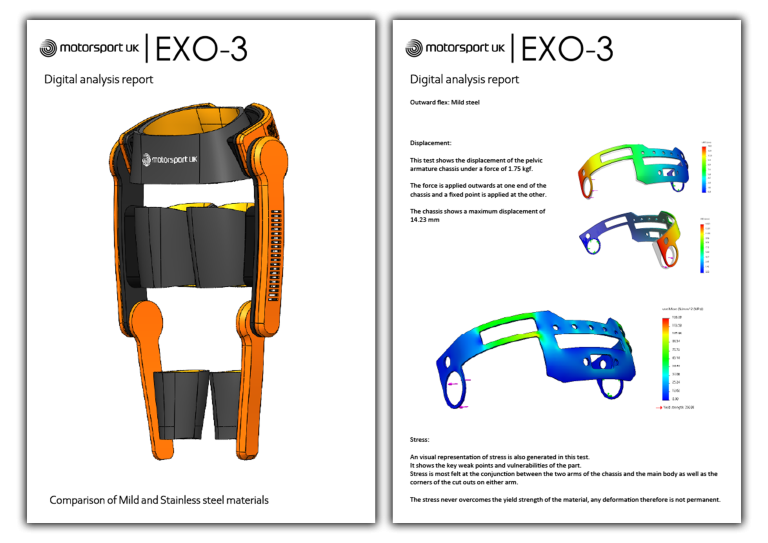
Technical development was a key part of the project. Digital analysis compared mild and stainless steel for the pelvic chassis across outward flex, inward flex and torsional loading. Under the stated test conditions, mild steel performed slightly better in displacement while also showing a lower estimated lifecycle impact, making it the stronger final choice for the chassis.
The analysis also informed a revised chassis design. Stiffening features were added, cut-outs were simplified and radii were increased to distribute stress more effectively, reducing outward-flex displacement from 14.23 mm to 7.35 mm under the same 1.75 kgf load case.